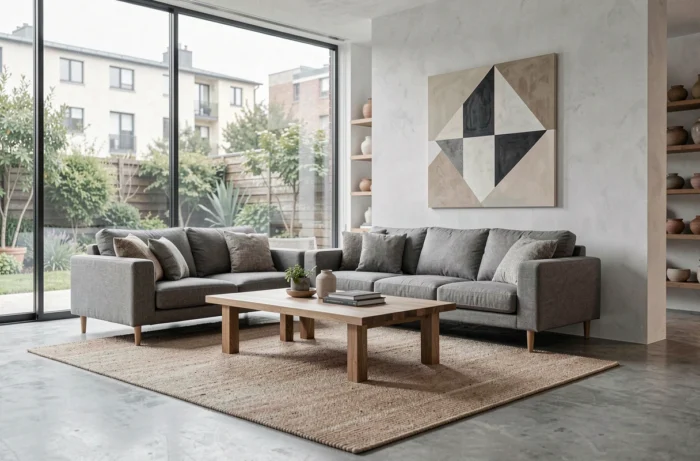
Modern decoration is no longer limited to white surfaces and cold lines. Recent projects favor earthy tones, tactile materials, and an approach where each piece of furniture has a real function. Here are ten concrete ideas to transform an interior without falling into catalog clichés.
1. Lime plaster walls to replace smooth paint
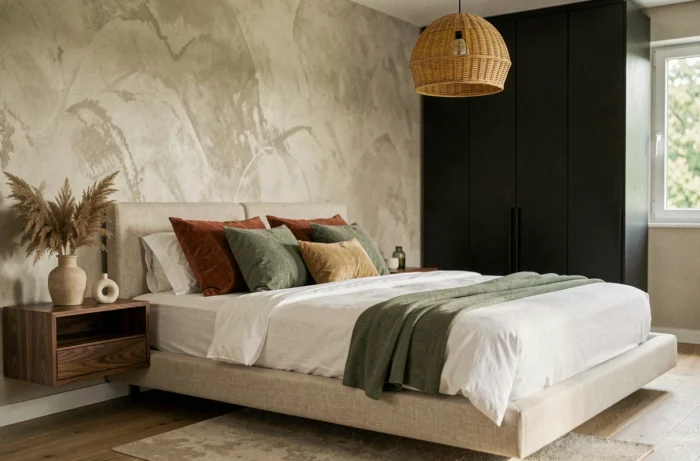
Lime plaster brings a lively texture that matte paint cannot replicate. Applied in irregular layers, it captures natural light and creates subtle shades that change throughout the day.
This material is particularly suitable for living spaces facing south or west, where the low light reveals the grain of the wall. In clay or off-white tones, it anchors a living room in a modern palette without coldness.
Its limitation: application requires specific expertise. Poorly mixed plaster can dust or crack, necessitating the hiring of an experienced craftsman or practicing on a secondary wall.
2. Modular furniture for dual-function spaces
Recent interiors are designed to change function: a desk that transforms into a guest bedroom, sliding partitions, furniture on wheels. This logic responds to the reduction of space in urban areas.
A sofa with a removable back, an extendable table, or repositionable shelves allow you to reconfigure a room without renovations. The main selection criterion remains the sturdiness of the mechanisms, often sacrificed in entry-level models. You can discover modern decoration with Bossa Studio Déco to identify manufacturers that combine modularity and durability.
3. Indirect lighting with recessed LED strips
A central ceiling light crushes the volumes. Recessed LED strips in a ceiling groove, under a suspended piece of furniture, or along a niche create luminous layers that structure the space.
The color temperature makes all the difference. For a living room, a light around 2,700 kelvins (warm white) remains the standard. Field reports vary on this point for kitchens, where some prefer to move towards a neutral white for visual comfort at the work surface.
4. Natural stone as a screen or partial cladding
Using stone on an entire wall often weighs down the room. In contrast, a screen made of reconstituted stone or cladding limited to an alcove adds depth without saturating the space.
Textured stone is gradually replacing large-format tiles in entries and bathrooms. Travertine, for example, offers an irregular veining that matches the ochre and warm brown tones found in current palettes.
5. Natural fiber textiles to soften the rigidity of furniture
Crumpled linen on cushions, boucle wool on an armchair, thick cotton for curtains: natural fibers soften an interior with geometric lines. They also absorb some sound, a real advantage in open spaces with hard floors.
The common pitfall is to multiply textures without color coherence. Two or three materials in a tight color range (ecru, sand, greige) work better than a patchwork of colors.
6. Color palette anchored in local light
Choosing a color from a paint sample in-store, under artificial lighting, often leads to disappointment. Recent publications recommend observing the natural light in the room at different times before settling on a paint.
- In regions with limestone constructions, warm ochres and browns extend the outdoor environment indoors.
- In coastal areas, off-whites and faded blues capture the cooler brightness without appearing dull.
- North-facing rooms gain warmth with clay or terracotta shades rather than gray, which accentuates the feeling of lack of light.
Testing a paint sample on-site for several days remains the most reliable method to avoid an unsuitable choice.
7. Reuse of materials for furniture and coverings
Beyond the vintage aesthetic, reuse responds to an environmental logic that is gaining ground. Recent projects highlight removable, repairable, and reinstallable elements: construction boards transformed into shelves, old doors repurposed as headboards, reclaimed tiles for a backsplash.
This approach requires sourcing time (reuse centers, demolition sites, professional flea markets) and checking the structural condition of the pieces. A poorly prepared reused material ages faster than a new one, negating the economic and ecological benefits.
8. Structured indoor vegetation in volumes
An isolated plant on a piece of furniture does not have the same effect as a grouping of plants at varying heights. Combining a large floor plant (like a ficus or strelitzia), a trailing plant at height, and a few pots on a shelf creates a true green volume.
The choice of containers is as important as that of the plants. Handmade ceramics, raw terracotta, or polished concrete integrate better into modern decoration than shiny plastic planters.
9. Integrated and flush storage for a clutter-free living room
Storage furniture placed against a wall fragments the visual line. Flush cabinets, with doors painted in the same shade as the wall, create a continuous surface that visually enlarges the room.
This type of layout requires custom intervention and a budget higher than that of a standard bookshelf. Available data does not allow for a reliable price range, as the gaps vary according to materials and installation complexity.
10. Handmade ceramics as decorative and functional elements
Vases, bowls, lighting fixtures in stoneware or glazed earthenware bring a deliberate irregularity that contrasts with industrial perfection. Handmade ceramics serve both as decorative objects and as utilitarian pieces (tableware, candle holders, storage dishes).
- Favor pieces with matte or semi-matte finishes, which align with the warm minimalism of current interiors.
- Group objects in pairs or threes on a tray rather than scattering them throughout the room.
- Check that the glaze is food-safe if the item is also used in the kitchen.
Modern decoration is less about a fixed style than about coherence between materials, light, and the actual uses of each room. The ten ideas listed here share a common thread: they start from the context of the housing (orientation, surface, light) rather than a trend disconnected from the place.