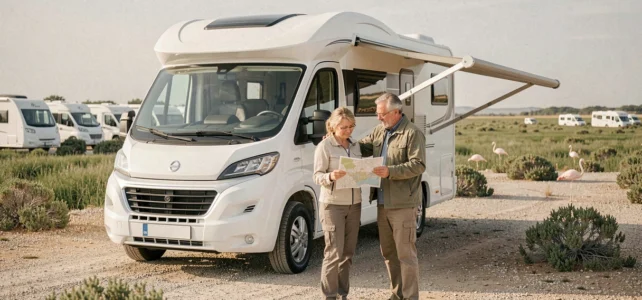
The motorhome area of Saintes-Maries-de-la-Mer, avenue d’Arles, remains one of the busiest parking spots in Camargue. The feedback published on Park4Night and specialized forums converge on several technical points that deserve careful reading before committing, particularly regarding water management and service slots.
Water access slots and waste disposal: an unusual constraint
The area on avenue d’Arles operates under a rare system in France: water is only available during two restricted slots, in the morning from 8:00 AM to 11:30 AM and in the evening from 4:00 PM to 7:00 PM. The toilets follow the same time frame. For a crew arriving in the early afternoon with an empty tank, the situation quickly becomes uncomfortable.
This hourly rationing system is not trivial. It requires the motorhome user to adapt their travel schedule to the area’s hours, which contradicts the logic of roaming. We observe that this type of restriction is multiplying in the municipal areas along the Mediterranean coast, often justified by the pressure on water resources during the summer months.
By comparison, the West Beach area, also in Saintes-Maries-de-la-Mer, offers waste disposal and water access freely. Its displayed rate is 16 euros per day, compared to 13 euros at the avenue d’Arles area. The three-euro difference buys real logistical comfort. Feedback published on several platforms like Park4Night describes a motorhome area in Saintes-Maries-de-la-Mer that operates correctly, but the time constraints remain the main friction point.
Parking limited to 48 hours: regulatory framework and effective control
The area’s regulations set a maximum parking duration of 48 hours. Control is carried out every morning by the municipal police, who check for presence and collect payment. Several reviews mention a visit as early as 8:00 AM, with a knock on the vehicle door.
This point deserves to be linked to the general legal framework. A parked motorhome is legally considered a vehicle. A mayor cannot generally prohibit the parking of motorhomes without a justified and proportionate order. The 48-hour limit constitutes a classic restriction, but it must be based on a properly formalized municipal order.
In practice, motorhome users wishing to extend their stay beyond two nights must turn to a campsite or private parking. The distinction between parking and camping remains the dividing line: as long as the vehicle is not “camping” (awning deployed, table set up, blocks on the ground), it is parked. Wild camping and waste disposal outside authorized areas remain prohibited, regardless of the duration of presence.
Lack of shade and full sun exposure: impact on autonomy
All feedback confirms it: the parking lot is paved, with no shaded areas. In Camargue, between June and September, ground temperatures far exceed comfort thresholds. The direct impact is measured on electricity consumption.
A motorhome refrigerator in full sun consumes significantly more than in the shade. Without an electrical connection at the avenue d’Arles area, the onboard battery is the only source of energy. Electrical autonomy becomes the limiting factor of the stay, more so than water or the location itself.
We recommend crews equipped with solar panels to check their actual output on reflective asphalt. Heat reduces the efficiency of photovoltaic cells, sometimes significantly. For vehicles without solar power, two nights represent roughly the battery autonomy limit with reasonable usage (lighting, water pump, refrigerator).
Points to check before settling in
- Level of the clean water tank: plan to arrive with sufficient filling to cover the first night, as water is only accessible during restricted hours.
- Charge of the onboard battery: without an electrical terminal, consumption in full sun can drain a standard auxiliary battery in less than two days.
- Condition of the ground: the asphalt heats the tires and the vehicle floor. Insulating blocks under the stabilizer jacks protect the pads.
- Arrival time: aim for a water opening slot to secure filling as soon as you settle in.
Tensions around motorhome parking in Camargue: local context
Recent reviews report a rise in friction between motorhome users and locals in several municipalities along the Mediterranean coast. Saintes-Maries-de-la-Mer is not exempt from this trend. Restrictive municipal orders are multiplying, sometimes contested legally.
The crux of the problem lies in the blurred distinction between parking and prolonged stays. A motorhome has the right to park on public roads like any vehicle, but the practices of some crews (long-term occupation of the same spot, wild dumping) fuel tensions. The result: restrictions that penalize all motorhome users, including those who follow the rules.
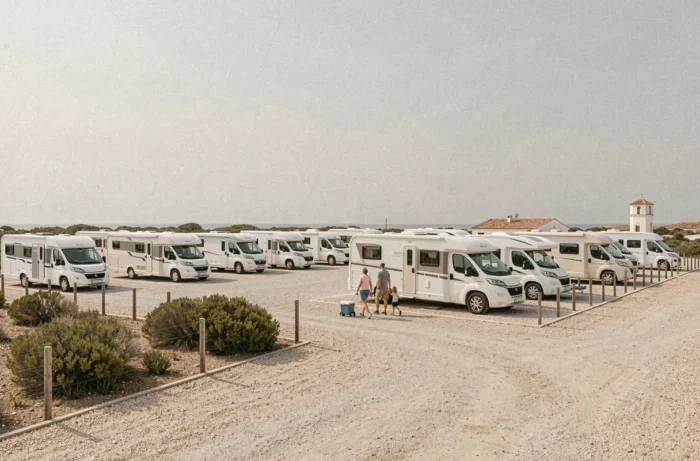
The area on avenue d’Arles, with its daily control system and 48-hour limit, represents a compromise between tourist reception and flow management. It remains functional and well-located, in immediate proximity to the village and the beach. The spots are large, which avoids crowding between vehicles.
The choice between this area and the West Beach area depends on the crew’s profile. For a short stay with a well-autonomous vehicle, the avenue d’Arles area offers a good location-price ratio. For a need for free water and a slightly higher budget, the West Beach will be more suitable. In both cases, the high season requires an early morning arrival to hope to find a spot.