
Choosing a carpooling app for your commute doesn’t mean looking for the most well-known one. The business model (with or without commission), the density of the network in your employment area, and compatibility with your employer’s sustainable mobility package weigh much more than the number of downloads. Here are four platforms ranked according to their relevance for daily use in 2026.
A point often overlooked in the comparison of carpooling apps: the national bonus for the first trip, long highlighted, is no longer an automatic benefit. Financial interest now relies on the actual sharing of costs, aids provided by certain local authorities, and the sustainable mobility package that your company may offer. This framework changes the game for distinguishing between apps.
1. Karos: matching algorithm for commuting
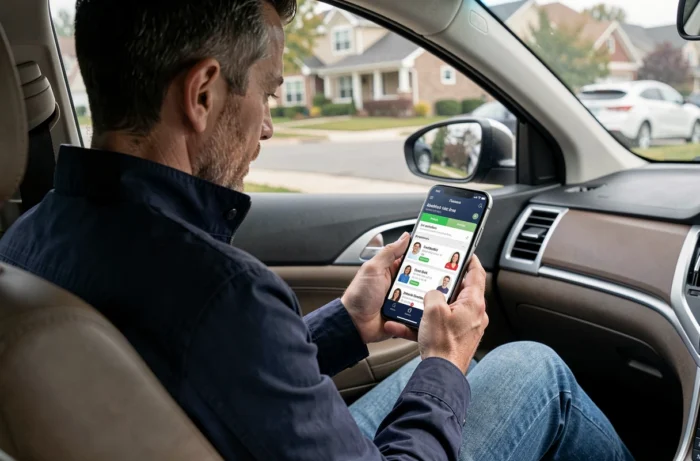
Karos stands out with an algorithm that analyzes your travel habits to automatically suggest compatible rides. You enter your schedule and your recurring route, and the app detects drivers or passengers whose itinerary intersects with yours, sometimes within a few hundred meters.
This passive operation is a real advantage for daily use. No need to post an ad every morning: Karos generates proposals without manual action. The app has formed partnerships with local authorities and companies, allowing it to cover specific employment areas, especially in suburban zones where public transport options remain limited.
The limitation lies in the size of the network. Outside partner territories, the number of active carpoolers may be insufficient to find a reliable ride five days a week. Check if your municipality or employer has signed an agreement with Karos before committing.
2. BlaBlaCar Daily: the largest network for short trips

BlaBlaCar Daily (formerly BlaBlaLines) leverages the massive user base of BlaBlaCar to offer short-distance carpooling. The idea is simple: you indicate your recurring route, and the platform connects you with drivers close to your itinerary.
The main advantage is the density of the network, especially in Île-de-France and major regional cities. More users mean more chances of finding a driver compatible with your schedule, even in case of last-minute changes.
Regarding the business model, BlaBlaCar Daily charges a commission on each trip. For a passenger, the cost remains moderate on a short trip. For a driver, the amount received after commission covers part of the fuel costs, nothing more. Have you noticed that on a fifteen-kilometer trip, the commission can represent a significant portion of the total price? That’s the compromise to accept to access the most extensive network.
3. Mobicoop: commission-free carpooling and cooperative model

Mobicoop is based on a radically different model: no commission charged on trips. The entire contribution from the passenger goes to the driver. This pricing transparency attracts users tired of seeing a portion of their contribution captured by the platform.
The operation is cooperative. Mobicoop is funded through services to businesses and local authorities, not by taking a cut from each ride. For commuting, the absence of commission makes carpooling profitable even over very short distances, where other apps leave the driver with a symbolic amount.
The downside of this model lies in the number of active users. Mobicoop has a smaller community than BlaBlaCar Daily or Karos. Here are the situations where Mobicoop makes the most sense:
- Your company has implemented a mobility plan that references Mobicoop as a partner platform
- You make a short trip (less than twenty kilometers) where the commission from other apps eats up almost all of the cost-sharing
- You are looking for regular carpooling with a stable crew rather than different matching every day
4. PassPass Covoiturage: the local solution for business areas

PassPass Covoiturage addresses a concrete problem: connecting employees from activity zones poorly served by transport. The system operates on a territorial scale, bringing together neighboring companies around a common matchmaking platform.
In the east of the Somme, for example, several hundred employees are already sharing their trips via PassPass. The principle relies on the geographical proximity between companies in the same area, which multiplies the possible ride combinations without depending on a national network.
This territorial model offers an advantage that large platforms struggle to replicate: neighboring companies discover each other and pool their flows. An employee finishing at 5 PM in one company can carpool with a colleague from a neighboring company finishing at the same time, without either having ever crossed paths.
The downside is clear: if your employment area is not covered by PassPass, the app will be of no use to you. Check with your HR department or your community to see if a rollout is planned.
Sustainable mobility package: the criterion to check before choosing
Regardless of the app chosen, check if your employer offers the sustainable mobility package. This system helps cover part of your carpooling costs, and not all platforms generate the necessary certificates for reimbursement. Karos and BlaBlaCar Daily generally include this feature. For Mobicoop and PassPass, compatibility depends on agreements made with your company.
The final choice depends on three variables: the app’s coverage in your employment area, the acceptable commission model for you, and your employer’s support. Testing two apps in parallel for two weeks remains the most reliable method to decide.