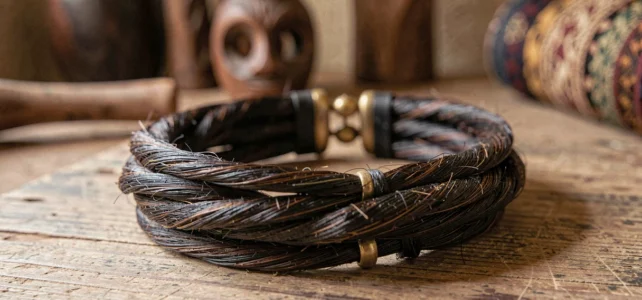
The elephant hair bracelet is not just another ethnic jewelry piece. Its raw material, the hair taken from the animal’s tail, determines both its mechanical properties and the symbolic weight attributed to it by African traditions. Understanding this object requires an intersection of ethnographic reading, regulatory constraints, and the material reality of keratinous hair.
Keratin Structure of Elephant Hair and Its Impact on Ritual Weaving
Elephant tail hair is a rigid keratin fiber, significantly thicker and more brittle than horsehair. This rigidity imposes specific weaving techniques: prolonged soaking softens the fiber without altering its tensile strength, allowing for the formation of ritual knots.
The tradition distinguishes two categories of bracelets based on the number of knots. The two-knot bracelet symbolizes the union of earth and nature, associating fertility, ancestors, and telluric forces. The four-knot bracelet aligns its wearer with four elements: fire, sun, water, and wind. The strands of hair represent the seasons, and the sliding of the knots along the strands illustrates the natural cycle.
This codification is not decorative. Each configuration of knots corresponds to a specific intention, and the artisan who weaves the bracelet engages in a form of ritual during its creation. The material itself, taken from a revered animal seen as a bridge between heaven and earth in African cosmogony, establishes the spiritual legitimacy of the object.
We observe that most mainstream articles describe the bracelet as a mere lucky charm, never detailing the connection between the physical properties of the fiber and the constraints of ritual weaving. The choice of the number of strands, their thickness, and the tension applied to the knots modify their mobility along the bracelet, and thus the symbolic “reading” that the wearer makes of it in daily life.
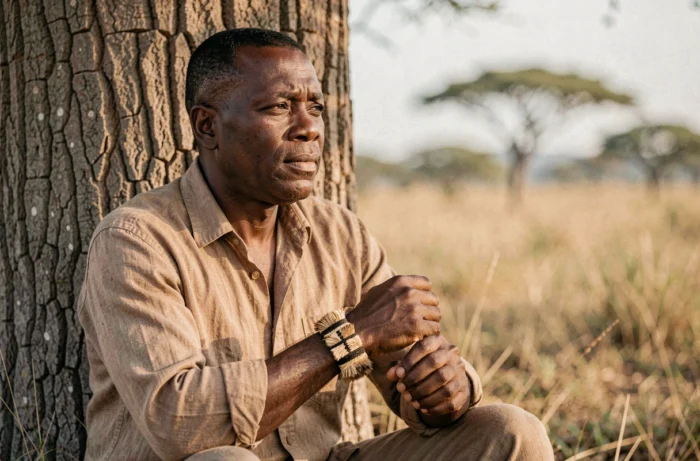
To delve deeper into the spiritual significance of the elephant hair bracelet, one must trace back to the African kingdoms where its possession marked a warrior or priestly status.
Symbolism of the Elephant: Beyond Wisdom and Strength
The elephant is systematically associated with wisdom, power, and memory. These generic attributes mask finer symbolic layers.
In African mythology, the animal is a mediator between the earthly and celestial realms. This cosmic bridge function transcends the simple metaphor of physical strength. It gives the hair, the most peripheral part of the animal’s body, a role as an interface: the hair touches the outside world, captures the dust of the earth, and endures the wind and sun.
Wearing a bracelet woven from this material, in this interpretative framework, means maintaining a fragment of this connection between two planes of existence. The bracelet is not a passive symbol. It is conceived as an active object, whose movement of the knots accompanies the wearer through the fluctuations of life.
- The elephant as a celestial animal: its massive stature is interpreted as a pillar connecting earth and sky, a constant in sub-Saharan African cosmogonies.
- The hair as a sensor: located at the end of the body, it is the point of contact between the sacred animal and the profane world, hence its talismanic value.
- The knot as a spiritual lock: each knot fixes an intention (protection, love, prosperity, balance) that the gradual sliding releases over time.
CITES Constraints and Cross-Border Trade of Authentic Bracelets
The tightening of CITES regulations in recent years radically changes the landscape for anyone wishing to acquire or sell an authentic elephant hair bracelet. Products derived from elephants are systematically seized at customs in an increasing number of countries, even when presented as souvenirs or spiritual objects.
Recently published customs compliance guides remind that possession of parts from protected species, even in the form of handcrafted jewelry, can lead to prosecution for wildlife trafficking. This legal reality applies regardless of the market value or cultural significance of the object.
Animal protection organizations now establish a direct link between the purchase of jewelry made from animal parts (ivory, bone, hair) and wildlife trafficking. Thus, the market for elephant hair bracelets finds itself caught between spiritual demand and increasing legal prohibition.
We recommend checking the CITES compliance of any bracelet before purchase, especially for pieces sold online. An origin certificate and documented traceability are the only guarantees of legality. Without these documents, a bracelet presented as authentic exposes its buyer to criminal penalties.
Synthetic Alternatives and Symbolic Transfer
In light of the restrictions, artisans are offering bracelets made from synthetic fibers that mimic the texture of elephant hair. The question that arises concerns the transfer of spiritual weight: can a bracelet made from artificial material retain the talismanic function of the original?
From a strictly ethnographic perspective, the answer is no. The power attributed to the bracelet relies on the physical link with the sacred animal. Severing this material connection removes the very foundation of the ritual.
From a practical standpoint, most contemporary wearers seek the symbolism of the elephant more than the material itself. The bracelet then becomes a medium for personal intention, decoupled from the original tradition. This shift is comparable to that observed for other ritual objects reappropriated outside their original cultural context.
- Authentic bracelet: strong ritual legitimacy, major legal constraint, increasing rarity.
- Synthetic bracelet: accessibility, legal compliance, but severing the material link with the animal.
- Bracelet made from horsehair or alternative natural fiber: possible compromise if the weaving respects the traditional codification of knots.
The elephant hair bracelet remains an object at the intersection of spirituality, craftsmanship, and international law. Its significance is not reduced to a vague lucky charm: it is anchored in a precise cosmogony where material, knots, and sacred animal form a coherent system. However, wearing this object today entails a legal and ethical responsibility that the mere quest for meaning cannot dismiss.