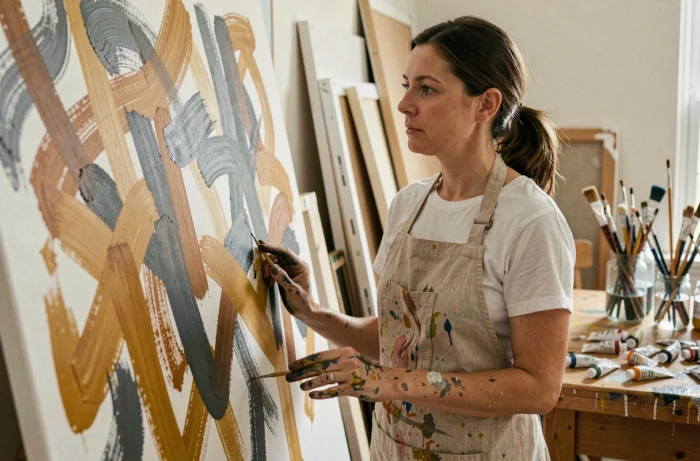
When you push open the door of a painting studio, the first thing that strikes you is not the canvas in progress. It’s the accumulation of gestures, crushed tubes, abandoned sketches that are then revisited. The creative universe of a passionate artist is not limited to a style displayed on a wall: it is built up in layers, between failed experiments and accidental discoveries.
Choice of pigments and supports: what guides an artistic practice on a daily basis
A detail that galleries rarely show: the selection of materials influences the final result as much as the gesture. Working with oil on raw linen does not produce the same effect as acrylic on mounted paper. Many female painters go through a prolonged testing phase before stabilizing a palette.
The support often dictates the direction of an entire series. A thick canvas invites impasto, while watercolor paper leans towards transparency. This is not a trivial choice, and it is generally made in the studio, in front of the material, not in front of a screen.
This grounded approach can be found on the homepage of Fannylng Art, where the exhibited works testify to a research process between materials and light.
Creation process in painting: from sketch to finished painting
Many imagine a flash of genius. The reality of the painting creation process resembles more a succession of technical decisions. It starts with a preparatory drawing, sometimes very rough, sometimes detailed in graphite pencil. Then come the first layers, often monochrome, that establish the structure of the composition.
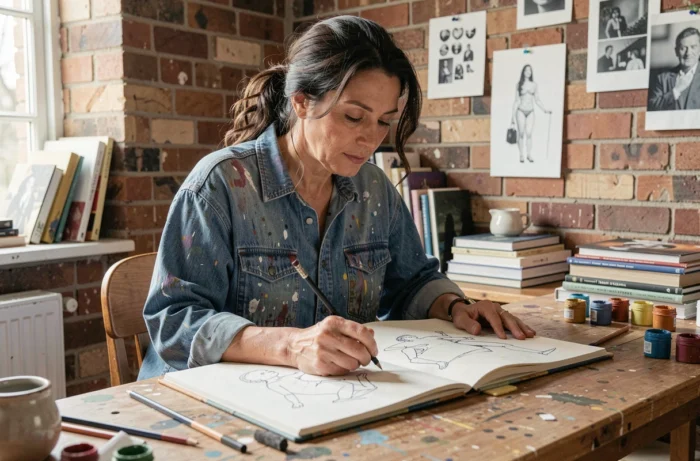
What distinguishes a personal approach is how the artist manages accidents. An unexpected drip can become a central element. The ability to integrate the unexpected into the work is part of the artistic language. We are not talking about mystical inspiration here, but about a know-how that refines with the hours spent in front of the canvas.
The transition from sketch to finished painting also involves drying times, revisions, and stepping back. Artists who work in series generally keep several canvases going in parallel to avoid forcing the pace of a piece in progress.
Sources of inspiration in art: between direct observation and visual memory
When asking painters about their sources of inspiration, the answers rarely overlap. Some start from a light observed at a specific time. Others work from images stored mentally, without photographic reference.
Inspiration often arises from a constraint rather than an impulse. An imposed format, a theme for an exhibition, a leftover color on the palette. These limitations force choices that total freedom would not produce.
The history of art also provides a foundation. Looking at how a 17th-century painter treated light on a fabric can nourish contemporary work without it being visible in the result. We are talking about visual filiation, not copying.
What concretely feeds a research notebook
- Quick sketches taken on the spot during travels, sometimes in marker, sometimes in pencil, which serve as a bank of forms for upcoming compositions.
- Personal photographs cropped and reworked, used as a starting point but never reproduced identically on the canvas.
- Color associations noted in a notebook (shades observed in a landscape, reflections on a surface, contrasts between shadow and natural light).
- Visits to exhibitions that provoke not the desire to imitate, but the urge to respond, to take an opposite direction, or to push a bias further.
Copyright and visual creation: what artificial intelligence changes for artists
We can no longer talk about a creative universe without addressing the legal framework surrounding it, especially since the emergence of generative AI tools in the visual field. A work created entirely by an algorithm does not automatically benefit from copyright protection in France. Protection depends on the existence of identifiable human creative intervention: selection, composition, retouching, or artistic direction, according to the interim report from the CSPLA published by the Ministry of Culture.
For a female painter who occasionally uses AI as an exploratory tool (to generate composition variants, test palettes), the question arises very concretely. Documenting her creation process becomes a protective reflex: keeping preparatory sketches, screenshots of the prompts used, and steps of manual retouching.
Tracing each step of the creative process protects the authorship of the work. This is not bureaucracy: it is what allows demonstrating the human part of the work in case of a dispute.
Opposition to data mining: a still little-known right
The French framework for text and data mining allows artists the possibility to oppose the commercial use of their works. Specifically, if images published online are used to train an AI model without permission, the artist can oppose it. Responses on this point vary according to platforms and jurisdictions, but the principle exists and is gaining visibility.
- Check the terms of use of the platforms where the works are disseminated (personal website, online galleries, social networks).
- Place explicit mentions of opposition to data mining on publication pages.
- Keep a dated history of each published creation to establish prior art in case of unauthorized reproduction.
The universe of a passionate painting artist is not limited to what is visible on the canvas. It includes material choices, research notebooks, hours of silent work, and now vigilance over how her images circulate. Artistic creation remains a manual and intellectual act, and it is precisely this human dimension that gives it its value, both legal and aesthetic.