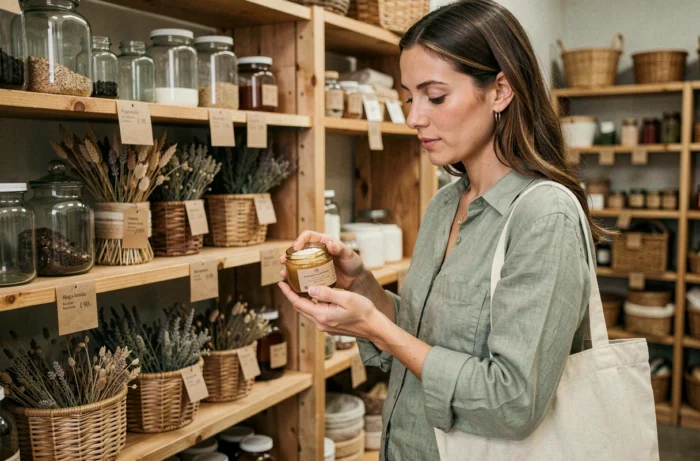
Eco-friendly shopping refers to the purchase of products whose manufacturing, transportation, and end-of-life have been designed to reduce the impact on climate, water, and biodiversity. Since October 2026, this concept has gained precision thanks to the expansion of the Ecobalyse tool, which allows for the calculation of the environmental impact of clothing by taking into account climate, water, biodiversity, reparability, recycling, and microfibers. This framework changes the game for both consumers and brands.
Textile environmental labeling: what Ecobalyse changes for green shopping
Until recently, comparing the actual impact of two textile products was akin to an obstacle course. Each brand could display its own in-house score, calculated according to rarely documented internal criteria. Textile environmental labeling is now verifiable by third parties, even without the cooperation of the brand in question.
Ecobalyse incorporates a specific factor related to fast fashion, penalizing ultra-fast production models. For brands that were already communicating about environmental impact, the obligation will be to display the official environmental cost, rather than a proprietary marketing indicator.
By browsing the shopping universe of Zaturelle, it is evident that the listed brands focus on the transparency of materials and manufacturing locations, a prerequisite that regulations now make measurable.
This regulatory shift has a direct consequence on consumption choices: a natural or eco-friendly product that displays a low Ecobalyse score (thus performing well) offers a guarantee that the self-proclaimed “green” label could not provide.

EmpCo Directive and “natural” claims: the end of ambiguity on eco-friendly products
The terms “eco-friendly,” “natural,” or “environmentally friendly” appear on thousands of product sheets online. The European directive Empowering Consumers (EmpCo) changes the rules of the game: generic environmental claims without verifiable proof become non-compliant.
In practical terms, an online store selling cosmetics or household products can no longer simply state “natural formula” without documenting the proportion of naturally sourced ingredients, their origin, and the transformation process. The directive also targets self-proclaimed labels that do not rely on any independent reference framework.
Criteria to check before buying a so-called natural product
- The detailed composition must be accessible, not just a mention of “plant-based” on the homepage. Compliant product sheets specify the percentage of naturally sourced ingredients and the standard used for the calculation.
- The place of manufacture must be indicated. The AGEC law requires textiles sold online in France to mention the composition and the country of manufacture.
- The displayed certifications (GOTS, Oeko-Tex, Cosmos Natural) must refer to an identifiable certifying body, not to a logo designed by the brand itself.
This proof requirement pushes eco-friendly marketplaces to tighten their selection criteria. The platforms that will survive are those capable of verifying supplier files, not those that merely collect declarative sheets.
Natural products online: distinguishing marketing trends from real commitment
The market for natural products covers a wide spectrum, from solid cosmetics to linen clothing, including zero-waste accessories. Three categories concentrate the attention of buyers in France.
Cosmetics and hygiene
Solid and refillable cosmetics dominate eco-friendly online sales. Shampoos, soaps, deodorants: the solid format reduces plastic packaging and transport weight. The real difference lies in the INCI list (International Nomenclature of Cosmetic Ingredients). A “natural” soap that contains synthetic sulfate surfactants does not hold the same promise as a cold-processed soap certified by Cosmos.
Ethical fashion and accessories
Organic cotton, hemp, linen grown in France: natural fibers are gaining ground in responsible shops. A common pitfall concerns “recycled cotton,” whose traceability often remains unclear. A responsible garment combines verified material, independent label, and documented manufacturing conditions.
Accessories (bags, pouches, cases) represent an accessible entry point for buyers discovering eco-friendly shopping. Their price remains moderate, and the impact of substitution compared to a conventional equivalent is immediate.
Home and cleaning
Concentrated household products, washable sponges, bee wraps: this category attracts customers looking to reduce their daily waste. The most significant trend here is bulk or refill sales, which require specific logistics from online shops.
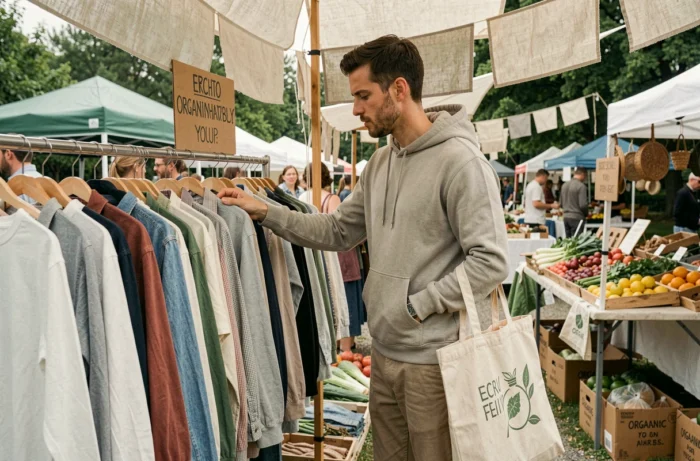
Reading an eco-friendly product sheet: reliable signals
In the face of the proliferation of reassuring mentions, a few reflexes allow one to separate real commitments from mere marketing dressing.
- The official environmental score, when available, takes precedence over any in-house label. A low Ecobalyse score on a textile is worth more than an “eco-friendly” badge without a reference framework.
- Transparency in the value chain: a brand that names its suppliers, workshops, and raw materials takes a real reputational risk, which in itself is a mark of seriousness.
- The absence of vague formulations: if the product sheet states “planet-friendly” without detailing how, the EmpCo directive considers this claim potentially misleading.
- The country of manufacture clearly displayed, in accordance with the obligations of the AGEC law for textiles sold online in France.
These checks take a few seconds per product. They are sufficient to eliminate the majority of offers that rely on undocumented greenwashing.
Eco-friendly shopping is entering a phase where proof matters more than promises. Between the Ecobalyse environmental display and the EmpCo directive, tools now exist to verify what a brand claims. It remains for consumers to use them, product sheet by product sheet.