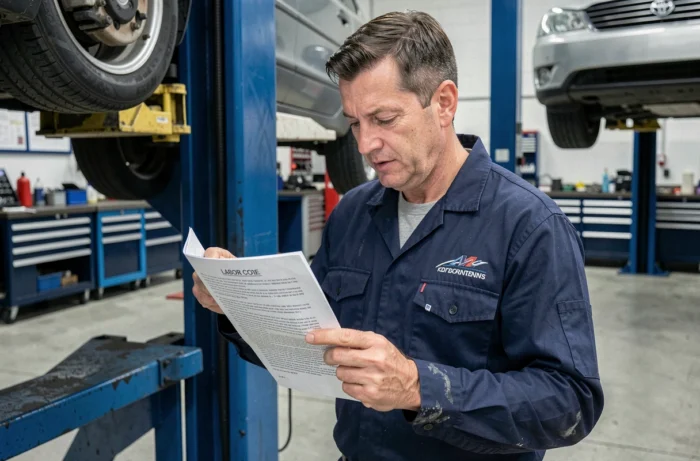
The French automotive sector relies on a legal framework that extends beyond the general Labor Code. The national collective agreement for automotive services (IDCC 1090) structures the relationships between employers and employees for the majority of activities related to sales, repair, and technical inspection. Understanding the interplay between this collective text and recent developments in labor law allows for an assessment of the actual obligations placed on companies in the sector.
Differences between the Labor Code and the automotive collective agreement
The collective agreement for automotive services covers a specific scope: sale of new or used vehicles, repair, technical inspection, rental, gas stations, driver training, dealerships, and auto centers. Employees in production plants or certain suppliers often fall under different agreements.
Several contractual provisions diverge from the legal foundation of the Labor Code. The table below highlights the main documented points of divergence.
| Theme | Labor Code (common law) | Automotive collective agreement (IDCC 1090) |
|---|---|---|
| Seniority leave | No additional days provided by law | Additional leave days granted based on employee seniority |
| Notice period for resignation/dismissal | Duration varies according to usage or contract | Specific durations by category: workers, employees, executives |
| Worked public holiday | No mandatory legal increase (except May 1st) | Compensation or recovery regulated by the agreement |
| Job classification | No national grid imposed | Own tier system (workers, employees, executives) |
These differences mean that an employer in the automotive sector cannot simply apply the Labor Code. The collective agreement sets often more favorable minimums than common law, and it takes precedence when it grants more to the employee.
To delve deeper into the administrative obligations related to these rules, the Labor Code on Auto Tech details the procedures specific to companies in the sector.

Working hours and schedule organization in automotive services
The organization of working time in the automotive sector follows specific rules. The collective agreement provides provisions on overtime, part-time work, and time savings accounts that complement or specify the Labor Code.
Overtime and modulation
The agreement allows for forms of work time adjustment over periods longer than a week. Overtime is subject to contractual increases whose rates may differ from the legal regime depending on the company or sector agreements in force.
Unusual travel time is also the subject of a dedicated article (article 1.09 ter of the agreement), which is not common in other sectors. For traveling technicians or employees sent for training, this provision clarifies the boundary between effective working time and travel time.
Part-time work
The agreement regulates the use of part-time work with specific guarantees. The additional hours and conditions for transitioning from part-time to full-time are detailed, offering clearer protection than the legal framework alone.
- The time savings account allows employees to store days off or leave for deferred use, according to the terms negotiated within the company.
- Daily and weekly rest periods are regulated by the agreement with specific thresholds, particularly for activities requiring continuity of service (emergency repairs, technical inspections).
- The use of on-call duty, common in garages and repair centers, is governed by contractual provisions that define the compensations owed to the employee.
Notice periods and seniority: what the agreement imposes by category
The notice period is one of the areas where the automotive collective agreement most distinctly differs from common law. The notice period varies according to the employee’s professional category: workers, employees, and executives are not subject to the same deadlines.
For workers and employees, the agreement provides notice periods in case of dismissal that increase with seniority. Executives benefit from longer deadlines, in line with their level of responsibility. In case of resignation, the durations are generally shorter but remain longer than what the Labor Code imposes by default.
Seniority grants additional leave rights in the automotive sector, a benefit that the Labor Code does not provide. This mechanism rewards employee loyalty and serves as a retention lever for employers facing a shortage of qualified technicians.

Transformations in the automotive industry and adaptation of labor law
The electrification of the vehicle fleet is transforming the maintenance and repair professions. Skills related to high-voltage systems, electrical safety, and electronic diagnostics are becoming central issues for workshops and subcontractors.
The agreement signed in the Grand Est for the period 2024-2027 illustrates this dynamic. Supported by the State, the Region, and social partners, it aims to support subcontractors furthest from manufacturers in adapting to new technologies. This initiative targets companies and employees who need to acquire skills in electromobility without having the internal resources of large groups.
Professional risk prevention is evolving in parallel. Working on electric or hybrid vehicles requires specific electrical certifications and safety protocols that labor regulations are gradually incorporating. Training in high-voltage risks becomes mandatory for workshops that work on these vehicles.
However, the IDCC 1090 collective agreement does not automatically cover employees of automotive production plants or those of certain suppliers, who may fall under distinct agreements (metallurgy, plastics). This distinction between services and industry remains a frequent source of confusion for both employers and employees.
The legal framework for work in the automotive sector is not limited to a salary grid or notice periods. The overlap of the Labor Code, the collective agreement, and regional agreements creates a set of rules where each category of employee has differentiated rights. For companies in the sector, legal monitoring of these three levels of texts determines the compliance of their daily practices.