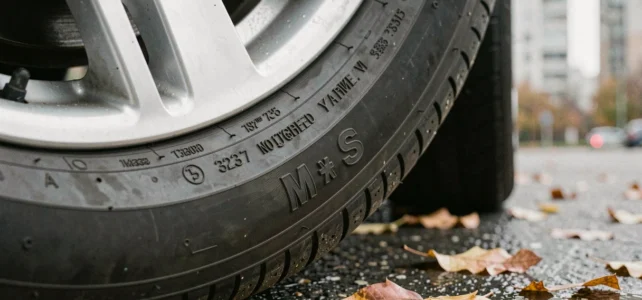
The M+S marking remains one of the most misunderstood labels on a tire’s sidewall. Unlike the 3PMSF pictogram, it relies on a self-declaration from the manufacturer, without a standardized testing protocol. This distinction, often lost in commercial discourse, nonetheless conditions regulatory compliance and the actual behavior of the tire on degraded road surfaces.
M+S Approval Protocol: A Self-Declaration Without Standardized Testing
The M+S marking (Mud and Snow) is not subject to any braking, traction, or driveability tests overseen by an independent organization. The manufacturer places the label on the sidewall as soon as they believe that the tread design and compound provide acceptable performance on mud and light snow. No measurable performance threshold is required.
The 3PMSF (Three Peak Mountain Snow Flake), represented by a snowflake inside a three-peaked mountain, on the other hand, requires a traction test on compacted snow compared to a reference tire. Only the 3PMSF constitutes a verified approval in the technical sense of the term. All tires bearing the 3PMSF symbol also display the M+S marking, but the reverse is not guaranteed.
We recommend considering the M+S as an indicator of design aimed at light winter conditions, not as proof of performance. A tire that is only M+S may have a compound that is too hard or treads that are too shallow to provide adequate traction below zero degrees.
For those who wish to delve deeper into this point, M+S tires explained on the Le Véridique website detail the declarative framework of this marking precisely.
Compound and Tread Design: What Separates an M+S from a True Winter Tire
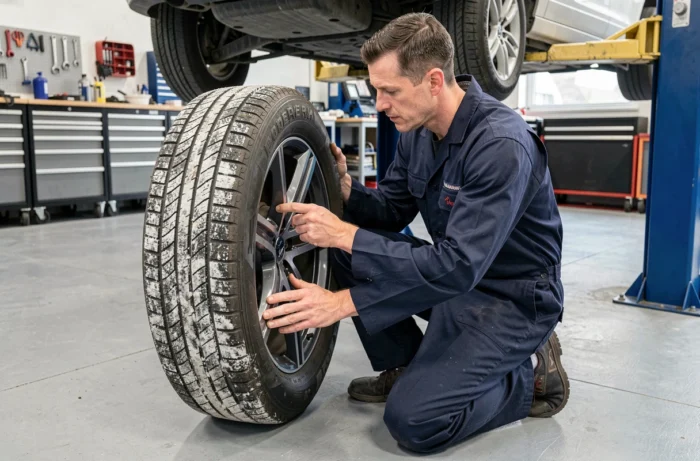
The difference between a tire stamped M+S and a 3PMSF winter tire is not just a logo. It hinges on two technical parameters that determine road holding at low temperatures.
Compound Hardness and Glass Transition Temperature
A typical summer tire hardens below about seven degrees. Its rubber loses elasticity, which reduces the effective contact area and increases braking distances. 3PMSF tires incorporate a silica-based compound that maintains flexibility well below this threshold.
An M+S tire without 3PMSF often uses an intermediate compound, softer than a summer tire but insufficient for prolonged negative temperatures. This compromise works in regions with mild winters, but not in mountainous areas.
Density of Sipes and Depth of Grooves
The tread of an M+S tire generally features wider blocks with deep grooves, designed to evacuate mud and slush. A 3PMSF tire goes further with a significantly higher density of sipes, which multiplies the gripping edges on compacted snow and ice.
- M+S tire only: open tread, spaced blocks, good mud evacuation, few sipes.
- 3PMSF tire: high-density sipes on each block, low-temperature silica compound, tested traction on snow.
- High-end all-season tire: often bears both markings, with an acceptable tread/compound compromise year-round.
Mountain Law and M+S Tires: An Officially Ended Tolerance
As of November 1, 2024, the transitional period that allowed M+S-only tires in areas subject to the Mountain Law has ended. To be legally compliant between November 1 and March 31, a vehicle must have 3PMSF tires or be equipped with chains or snow socks.
The regulations provide for a fourth-class fine and possible immobilization of the vehicle. The situation is more nuanced in practice: the decree organizing the fines has never been published, and the state has renounced implementing these sanctions. The obligation remains on paper, but no fines have been applied to date for lacking 3PMSF.
The main risk is not the fine but the insurance. In the event of an accident in a mountainous area with non-compliant tires, an insurer may invoke non-compliance with equipment obligations to reduce compensation. We observe that this paradoxical situation drives many motorists to keep M+S tires without 3PMSF, underestimating the insurance consequences.
All-Season Tires with Dual M+S and 3PMSF Marking: The Right Compromise
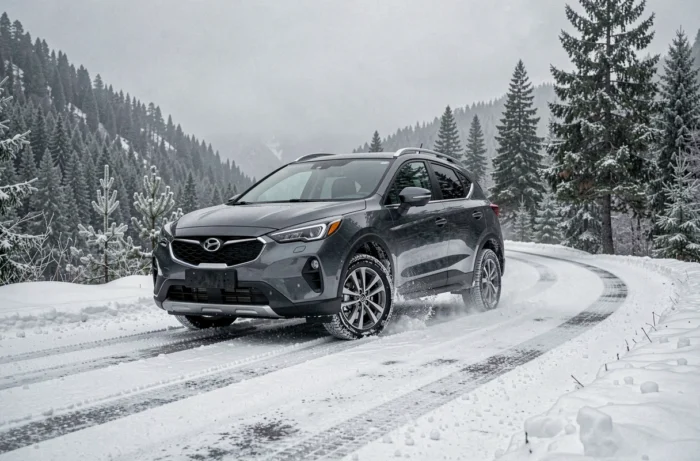
The all-season tire market has evolved significantly. Most recent models from major manufacturers now carry the dual M+S and 3PMSF marking. They pass the traction test on snow while maintaining acceptable performance on dry and wet roads in summer.
This type of tire is suitable for drivers who mainly drive in flat areas or urban peripheries and occasionally traverse mountainous zones. The dual-marked all-season tires eliminate the Mountain Law compliance issue without requiring a seasonal change.
Two limitations to keep in mind:
- Wear is faster than that of a dedicated summer tire, due to the softer compound necessary for low temperatures.
- Braking performance on snow remains inferior to that of a pure winter tire, even with the 3PMSF. The standardized test measures traction, not braking or lateral grip.
- On dry and warm surfaces, the braking distance of an all-season tire is significantly longer than that of a summer tire, due to the softness of the compound.
For utility vehicles and SUVs that frequently carry heavy loads, we recommend a dedicated winter tire rather than an all-season tire. The added mass accentuates the behavioral differences between the two categories, especially when descending on icy roads.
The M+S marking retains its usefulness as a first filter for reading a tire’s sidewall, but it does not guarantee winter performance or regulatory compliance. The 3PMSF has become the only reliable benchmark for assessing a tire’s actual suitability for cold conditions. Checking for the snowflake pictogram before purchase remains the simplest and most decisive technical gesture.